
Assignment 2
Step 1: Pick the corpus
In my case, I wanted to work on the three books of Fyodor Dostoyevsky. A quick look on Project Gutenberg and I chose these three: The Idiot, The Brothers Karamazov, and Crime and Punishment.
Step 2: Research the corpus
The three novels — The Idiot, The Brothers Karamazov, and Crime and Punishment — are considered some of Dostoevsky’s most important works. They each tackle profound philosophical questions:
-
The Idiot (1869):
- Book Reference: 2638
- Explores the idea of the “positively beautiful man” and the conflicts between innocence and societal corruption.
-
The Brothers Karamazov (1880):
- Book Reference: 28054
- Delves into moral struggles, faith, doubt, and the conflict between reason and emotion.
-
Crime and Punishment (1866):
- Book Reference: 2554
- A study of guilt, redemption, and the psychology of crime
Step 3: Corpus Analysis
The Role of Digital Tools
Utilizing Voyant Tools allowed me to engage in what’s known in literary studies as “distant reading,” where I could observe patterns, frequencies, and connections across the text without prior detailed reading. This approach was particularly enlightening for someone like me, who hadn’t read the book. It provided a macroscopic view of the narrative structure and themes.
The Idiot
Word Clouds and Frequency Analysis:
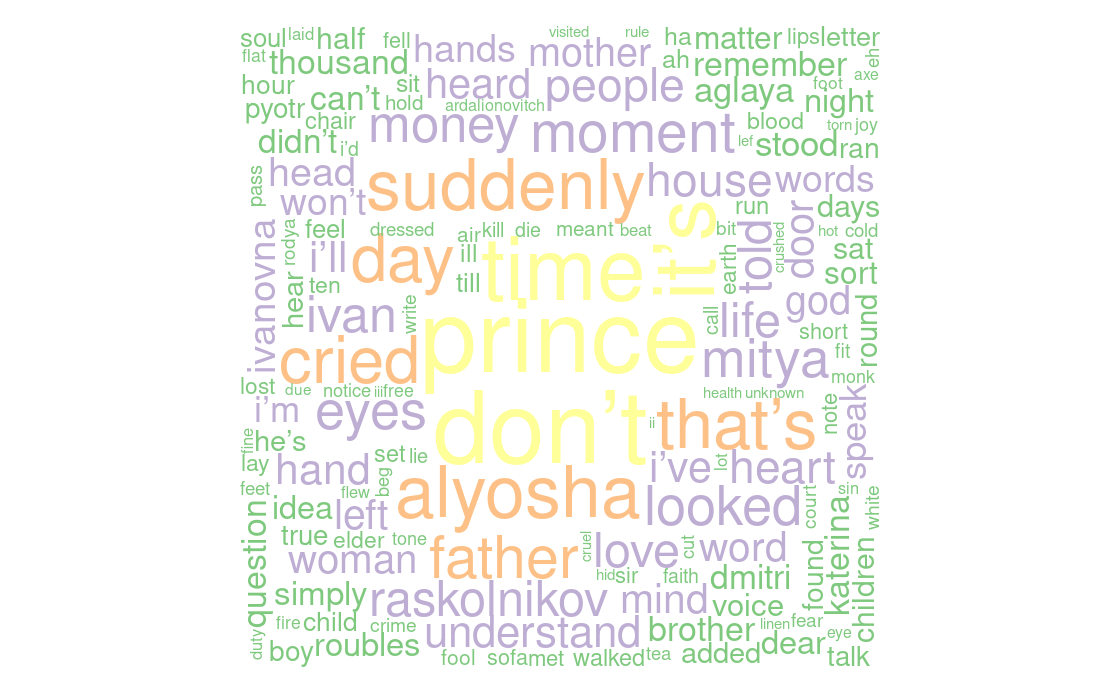
- The word clouds generated from “The Idiot” were immediately striking. Prominent words like “prince,” “Ivan,” and “father” popped out, suggesting their central roles within the narrative. The frequency of terms such as “suddenly” and “moment” hinted at a narrative deeply concerned with time and abrupt transitions, suggesting a volatile or dynamic plot structure.
Trends and Context Analysis:
- The trend analysis for the term “prince” revealed a consistent mention throughout the book, affirming the character’s central role in the narrative. This constant presence could imply that the Prince is likely the protagonist, around whom the major events and discussions pivot. The Keyword in Context (KWIC) analysis provided snippets of text surrounding the word “prince,” giving me a glimpse into how the character is perceived and interacts within the narrative framework.
- In addition, I decided to look into the “general”, “nastasia”, and “aglaya” keywords. According to the trends analysis, the trend of “general” became downward, a point could be made that the character died or played his role until the middle of the book. In contrast, the character “aglaya” played a small role in the beginning, but by the end became more “popular”.
The Brothers Karamazov
Continuing my journey into Fyodor Dostoevsky’s world, I delved into “The Brothers Karamazov” next. With no prior knowledge of the book, I was intrigued to see what digital analysis could unveil about its characters and themes.
Word Clouds and Frequency Analysis:
- The word cloud for “The Brothers Karamazov” immediately drew my attention to key terms like “father,” “Ivan,” “Alyosha,” and “Mitya.” These names dominate the visual, suggesting their central roles within the narrative. From the prominence of “father,” I could guess the plot might revolve around a patriarchal figure and his relationship with his sons.
Trends and Context Analysis:
- Mitya (Dmitri) shows a significant presence initially, which drops and then peaks again. This could indicate his crucial role in the beginning, perhaps a conflict or a pivotal moment that subsequently wanes but becomes important again towards the end.
- Ivan maintains a steady presence, peaking towards the middle and end, suggesting his ongoing involvement in key plot developments.
- Alyosha, interestingly, mirrors Ivan’s trend at the end, which could imply a convergence of their paths or themes towards the conclusion of the novel.
These trends could hint at a narrative intertwined around these three characters, possibly the eponymous brothers, each playing significant roles that intersect and diverge throughout the book.
Crime and Punishment
Diving into “Crime and Punishment,” I approached it with only a vague recognition of the name Raskolnikov, which I’ve heard mentioned in discussions about classic literature.
Word Clouds and Frequency Analysis:
The word cloud prominently features “Raskolnikov,” which immediately confirms his central role in the story. Other names like “Sonia,” “Razumihin,” and “Dounia” also stand out, suggesting their significance. The appearance of words like “thought,” “moment,” “come,” and “said” gives a hint of the narrative style—introspective, with a focus on dialogue and personal conflict.
Trends and Context Analysis
- Sonia’s relative frequency peaks dramatically towards the end, suggesting a pivotal role in the climax or resolution of the story. This spike in frequency made me curious about her character’s evolution and her relationship with Raskolnikov.
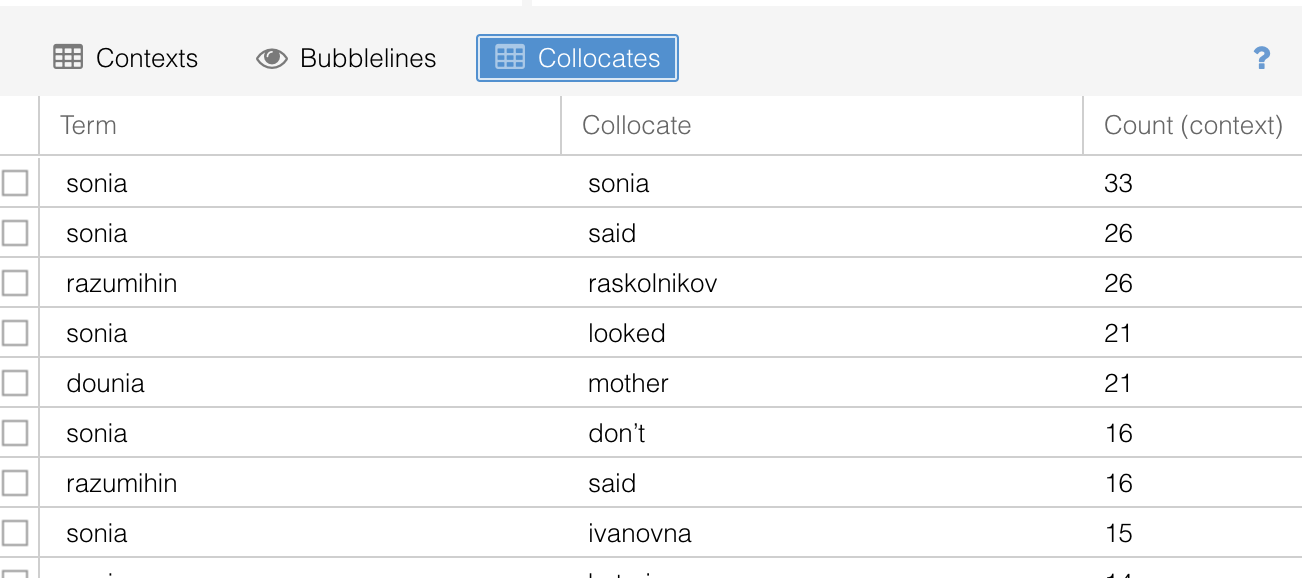
- Razumihin and Raskolnikov often appear together in collocates, indicating their frequent interaction within the text. This prompted me to check if Razumihin could be a nickname or related name, but he is a distinct character, a friend of Raskolnikov, which aligns with their linked appearances in the text.
- Dounia, interestingly associated with the word “mother” in collocates, led me to theorize about her familial role or protective nature, perhaps towards Raskolnikov. This connection enriched my understanding of her character’s dynamics within the story.
Step 4: Insights Gained
Having embarked on this journey through Fyodor Dostoevsky’s iconic texts with Voyant Tools as my guide, I’ve come to appreciate how digital tools can transform our interaction with literature, especially dense, philosophically rich texts like those written by Dostoevsky. My decision to focus solely on Voyant Tools was prompted by its efficiency and the depth of analysis it offered, which was on par with, if not superior to, what I could achieve using R for similar tasks.
Key Findings from Each Text
- The Idiot: Analysis highlighted the central role of the Prince, with themes revolving around innocence and societal corruption.
- The Brothers Karamazov: Revealed the philosophical debates between faith, doubt, and reason through the interactions of the Karamazov brothers.
- Crime and Punishment: Showcased the evolution of Sonia and Raskolnikov’s relationship, underpinning the themes of redemption and moral struggle.
Application of Digital Tools
Voyant Tools effectively dissected these complex texts, revealing underlying patterns and connections. The ability to track character mentions and thematic expressions helped understand the narrative structure and development, aligning closely with Dostoevsky’s philosophical inquiries.
Integration with Course Concepts
This project resonated with our coursework on “Data Organization in Spreadsheets,” where we learned the value of structured and clean data analysis. Applying these principles to literary analysis ensured a clear, organized approach to interpreting the novels, enhancing the reliability of my observations.
Conclusion
In conclusion, the project exemplified how digital tools can transform our interaction with literature, making complex philosophical texts more accessible and engaging. As I continue my studies, the skills, and insights gained from this experience will undoubtedly influence my approach to literary analysis, encouraging a more nuanced exploration of texts through advanced digital methodologies.